


Role of Chain Extenders in Polyurethane Foam
Role of Chain Extenders in Polyurethane Foam
Introduction
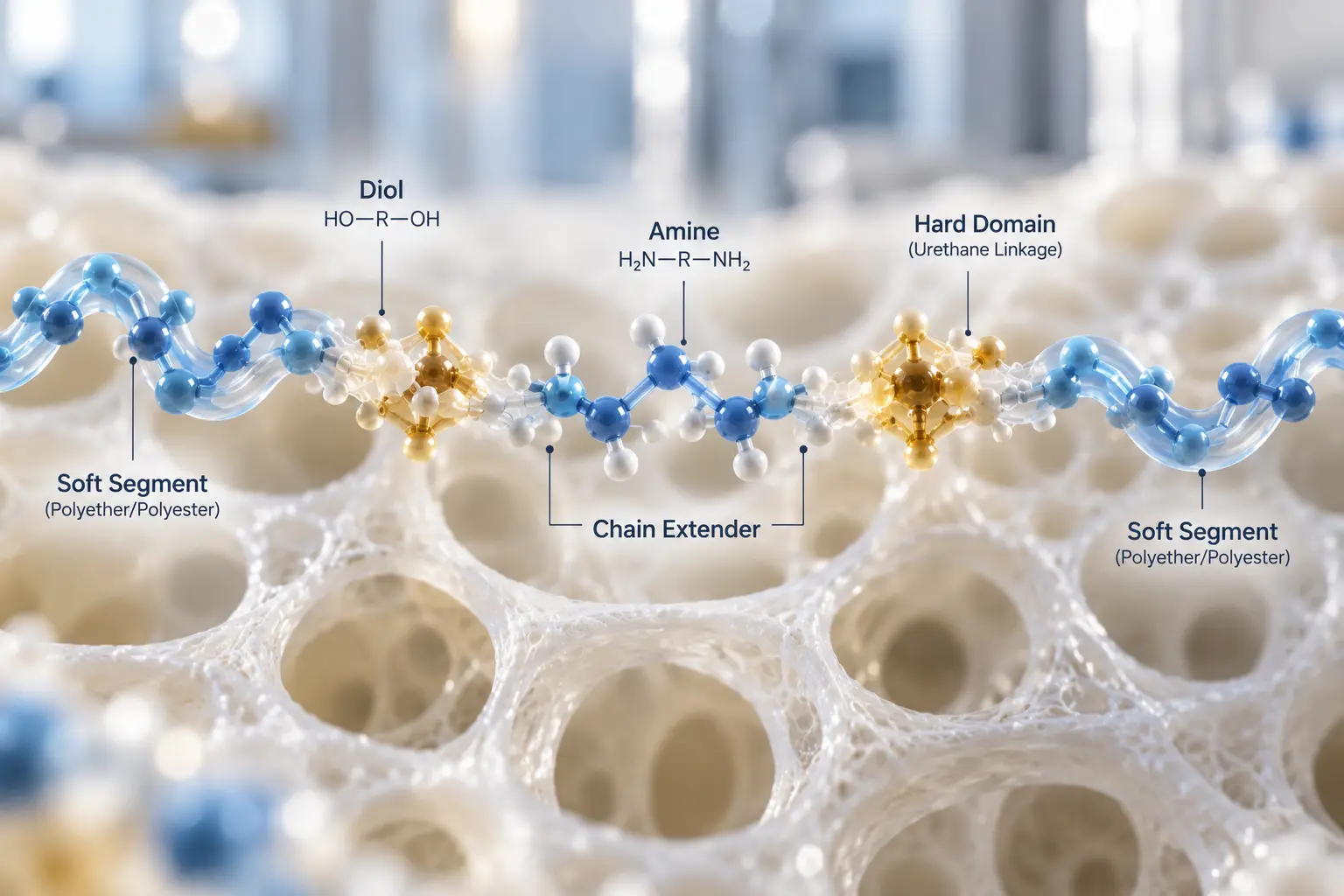
One of the important additives used in polyurethane foam formulation is a chain extender. Polyurethanes consist of two main segments: hard and soft segments. Isocyanate and the chain extender form the hard segment of polyurethane, while polyester polyol or polyether polyol forms the soft segment.
The hard segment contributes to increased strength and rigidity, while the soft segment provides the viscoelastic behavior of the foam. Therefore, by adjusting the balance between the soft and hard segments, different properties can be achieved in polyurethane foam.
This article examines the role of chain extenders in polyurethane foam as part of the hard segment. Chain extenders are low-molecular-weight compounds that can be alcohol- or amine-based. They react with isocyanates and increase the length of the hard segments in polyurethane.
When an alcohol-based chain extender is used, hard urethane segments are formed. In contrast, amine-based chain extenders lead to the formation of hard urea segments.
Role and Types of Chain Extenders in Polyurethane Foam
MEG and DEG are among the most important and commonly used alcohol-based chain extenders, while DEA and TEA are examples of amine-based chain extenders.
If the chain extender reacts too quickly, the foam may gel before the mold is completely filled or before the foam reaches its maximum volume. If the chain extender reacts too slowly, the time required for the polyurethane foam reaction increases.
The reactivity of the chain extender should be compatible with the other components of the polyurethane formulation in order to achieve the desired reaction times. At the same time, the chain extender must work effectively with the other components of the reaction mixture to produce polyurethane foam with the desired physical properties.
Effect of Ethylene Glycol on Polyurethane Foam Properties
Monoethylene glycol is used as a chain extender in polyurethane foams. It promotes stronger interactions between the hard and soft phases and increases strength. According to studies conducted by Zou and colleagues, increasing its content resulted in improved abrasion resistance, increased hardness, and reduced density.
When the gel reaction rate is lower than the blowing reaction rate, the cell walls have lower strength and cell rupture can occur over larger areas. The addition of ethylene glycol plays a positive role in the foam preparation process.
Due to the presence of primary hydroxyl groups in ethylene glycol and the increased amount of isocyanate, the gel reaction proceeds more rapidly.
Effect of Chain Extenders on Reaction Time and the Demoulding Process
The tack-free time (TFT) of polyurethane foam has an important effect on the demoulding process. The addition of ethylene glycol reduces TFT due to the increased amount of isocyanate and the higher reactivity of primary hydroxyl groups.
Ethylene glycol also accelerates the reaction and the formation of cross-links. Its low molecular weight and low viscosity improve penetration and mixing during the foaming process, allowing the hydroxyl groups to participate more effectively in the gel reaction.
Increasing the amount of ethylene glycol increases the gel reaction rate and reduces the tack-free time. In addition, increased heat release resulting from the exothermic reaction between ethylene glycol and isocyanate contributes to a reduction in tack-free time.
Effect of Chain Extenders on the Cellular Structure of Polyurethane Foam
When the gel reaction is accelerated and cell-wall strength increases due to the formation of additional hard urethane segments (Hard Segment Urethane), the bubbles grow more rapidly before they collapse.
Viscosity affects cell morphology and cell size. The addition of ethylene glycol reduces the initial viscosity and promotes the formation of more homogeneous bubbles. It also influences bubble expansion during the early stages of polyurethane foam formation.
Conclusion
The type and amount of chain extender in polyurethane foam are important factors affecting the mechanical properties and processability of the foam. Alcohol-based chain extenders such as EG exhibit higher reactivity due to the presence of primary hydroxyl groups.
Lower viscosity improves penetration, while an increase in the hydroxyl number of the overall matrix increases the required amount of isocyanate. Chain extenders are present in the hard segments of polyurethane foam and contribute to increased cell-wall strength. They also increase the exothermic nature of the reaction and can consequently help reduce demoulding time.


