


Foam Meter, A Quality Assessment System for Polyurethane Foam
Foam Meter: A Quality Qualification System for Polyurethane Foam
(Measurement of Quality Parameters During the Foam Formation Process)
About the Foam Meter and Polyurethane Foam Quality Control:
Key customers in the polyurethane industry, including manufacturers of automotive components such as seats and dashboards, furniture manufacturers, and producers of refrigerators and building insulation, are increasingly demanding consistent product quality. At the same time, automotive companies require their component suppliers to comply with stringent quality requirements. Therefore, foam manufacturers need to provide their customers with accurate information about the parameters involved in the foam formation process.
At the same time, manufacturers seek more precise control over the foam production process, particularly to ensure consistent product quality.
These requirements have led to the development of measuring systems for recording key characteristics such as foam rise (increase in foam height), temperature changes, pressure, and dielectric polarization during the foam formation process. Other parameters, including viscosity, gel time, and curing behavior, also provide valuable information about foam properties.
The Foam Meter is a measuring device that enables the measurement and recording of key characteristics of the foam formation process, including foam height, reaction temperature, rise pressure, and dielectric polarization. Additional information such as viscosity, gel time, and curing behavior can also be obtained from the measurement data, making this instrument a valuable method for determining the properties of the produced foam and making these measurements an important part of process documentation.
Introduction:
The quality of polyurethane foams depends strongly on what occurs during the foam formation process. Therefore, it is reasonable to record the formation parameters using suitable measuring instruments and regularly evaluate them on foam samples. Another advantage of these measurements is that they can help verify the consistency of the quality of the raw chemical materials before they are used in the final formulation.
Such monitoring is also highly valuable when developing new foam systems with specific properties. Measuring the formation parameters provides insight into how the reaction proceeds and how the foam formation process is affected by additives, blowing agents, stabilizers, and changes in the base formulation.
To achieve these objectives, the Foam Meter can be used to determine whether the foam meets stringent requirements in terms of measurement accuracy and repeatability.
Foam Rise Profile (Foam Fingerprint):
The traditional method for characterizing foams involves measuring the height of a rising foam sample in a cup or cylindrical container. In this test, the start time and the end of rise time are determined from the foam rise profile. Although these terms are not fully standardized, the start time generally refers to the beginning of the reaction between Component A (polyol + additives) and Component B (isocyanate) after mixing, while the end of rise time is the point at which the foam reaches its maximum expansion.
Ultrasonic sensors are highly useful for measuring the surface height of the rising foam, replacing manual measurement methods and reducing their associated uncertainties (Figure 1).
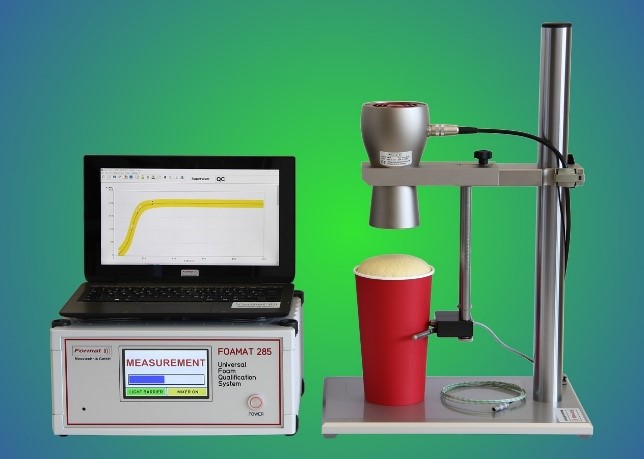
The characteristics of a new formulation can be evaluated by comparing its foam rise profile (Foam Fingerprint) with a reference curve, allowing the quality and consistency of the new formulation to be assessed.
Reaction Temperature:
The exothermic polymerization reaction causes the temperature inside the foam sample to increase. However, the temperature distribution within the sample is not uniform because it is affected by heat loss from the free upper surface of the foam, heat conduction through the walls of the container, the insulating properties of the foam, and the adiabatic expansion of the foam itself. Therefore, the point at which the temperature change is measured within the rising foam can be very important.
Experimentally, the maximum foam core temperature is best measured by positioning a thermocouple in the lower third of the total foam height. As the reaction continues, gelation of the foam components begins and pressure develops within the foam. Since the foam remains free to expand upward during pressure measurement, the ultrasonic sensor can simultaneously measure the increase in foam volume.
Rise Pressure:
During the gelation process, a matrix of stable cells is formed that restricts further expansion and also prevents the blowing agents from escaping. These two processes generate stress (pressure) within the foam, which can be detrimental in practical applications.
For example, during refrigerator production, metal sheets may be subjected to pressure perpendicular to the direction of foam rise. In many cases, considerable pressure forces are generated, requiring the production assembly to remain in the mold until the curing process is complete. In severe cases, these forces may even damage the component. Therefore, monitoring this parameter has become an important requirement in rigid foam production.
In the Foam Meter, because the local stresses generated during gelation strongly depend on the increase in foam height, changes in force are measured as rise pressure. While the foam rise profile primarily records the dynamics (kinetics) of blowing-agent formation, rise pressure reflects the properties of the foam cells influenced by the polymerization reaction. Rise pressure is measured using a metal mold into which the foam components can be poured (Figure 2). As the foam expands, it exerts pressure on the bottom of the mold, and the resulting force (pressure) is measured by a gauge.
The pressure curve also provides valuable information for actual production processes. It indicates the point at which the pressure begins to decrease and therefore helps determine when it is safe to open the mold. This allows manufacturers to identify the optimum demolding time and avoid post-expansion problems. It also enables them to optimize the time the component remains in the mold, avoid unnecessarily long demolding times, and improve production efficiency.
Dielectric Polarization:
Dielectric polarization is a measurement parameter that provides insight into the electrochemical processes occurring during foam formation. Dielectric polarization is primarily generated by chain-like molecules with large dipole moments due to their polar end groups, such as OH and NCO groups in PU and PIR foams. Chain formation occurs before the crosslinking reaction, and as curing is completed, dipole mobility ultimately comes to a halt.
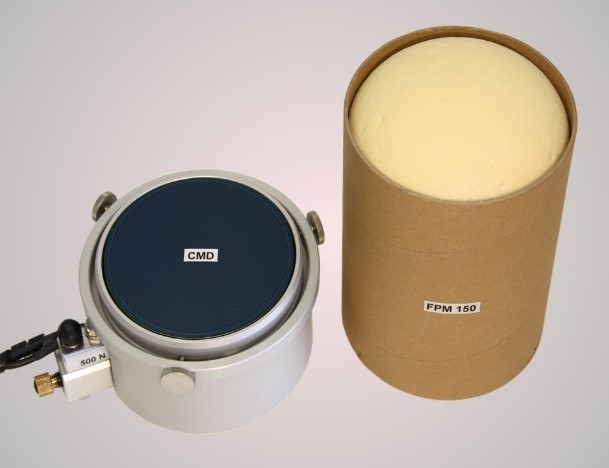
The dielectric polarization sensor (CMD) is located on the FPM pressure plate (Figure 3). As the pressure increases, the foam is compressed against the CMD surface. Dielectric polarization can indicate the formation of intermediate substances such as amines and the final curing of the foam, with the signal decreasing to a low and stable level after completion of the chemical reaction.
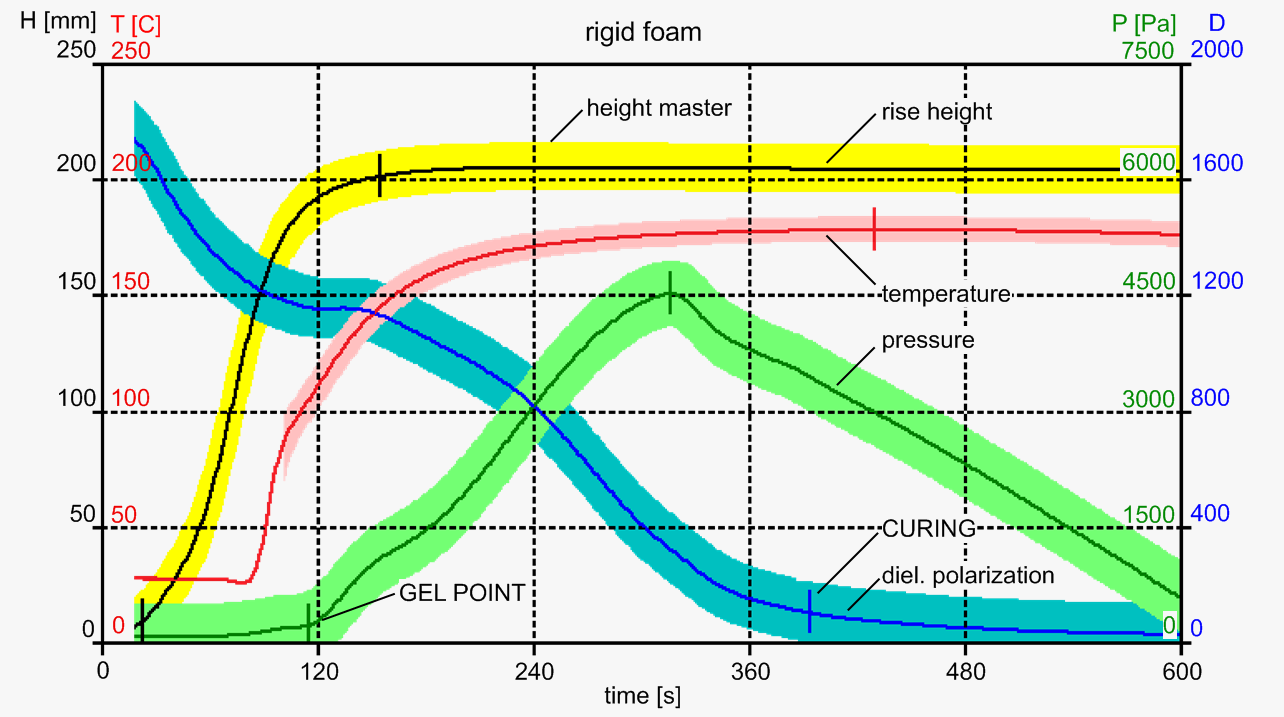
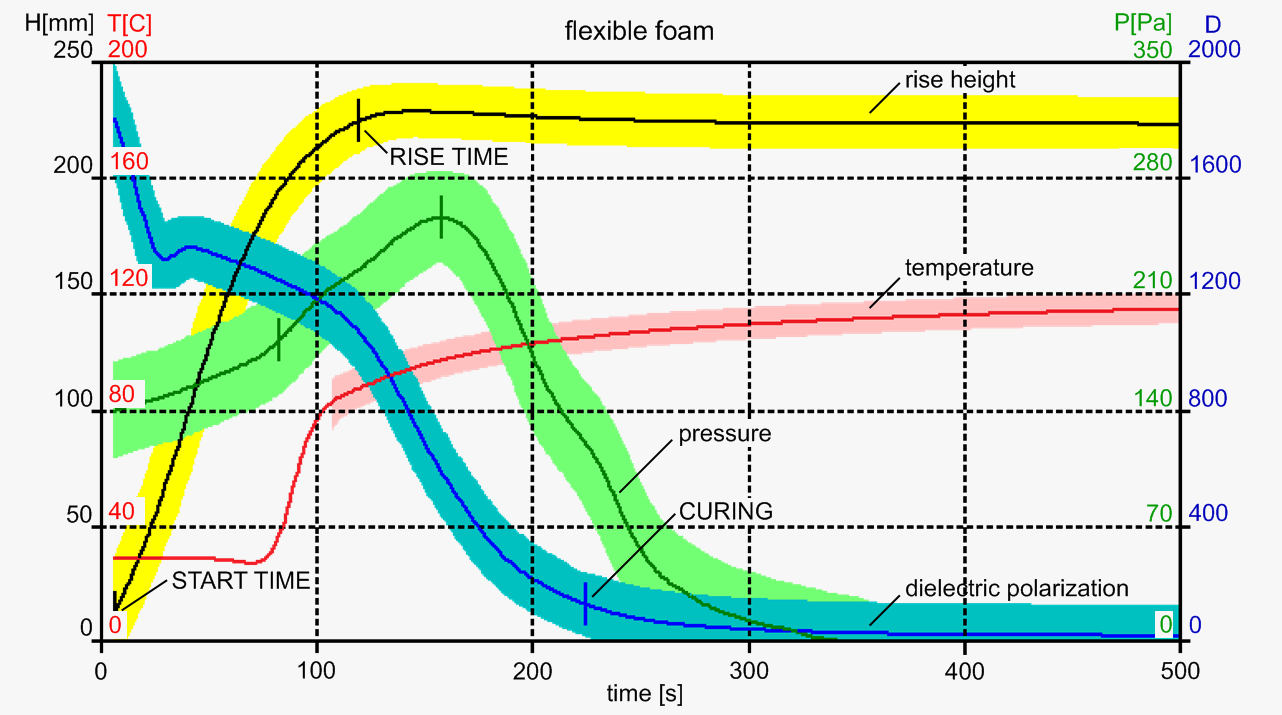
Example graphs for two types of rigid and flexible polyurethane foams are presented in Charts 1 and 2. In the following charts, the highlighted areas represent the reference bandwidth. If the test samples remain within this bandwidth, the new product shows no significant change in its fundamental properties. Using the Foamat system, quality managers can establish master curves for a wide range of relevant formulations and define corresponding reference bandwidths.
Chart 1 compares gel time, mold residence time, maximum temperature generated during the reaction, and maximum sample expansion with the reference values. For flexible foam, Chart 2 provides similar comparisons, including maximum rise time, sample collapse after completion of the rise period, maximum pressure and temperature, and pressure drop time, which indicates the required mold residence time.
References:
- Meeting product quality demands by monitoring PU foam formation: Bernd H. W. Hofmann
- Hagen-Poiseuille Equation: Essential Guide for Fluid Dynamics By Charlie Young, P.E.


